May 18, 2026
(reading time: 2 mins)
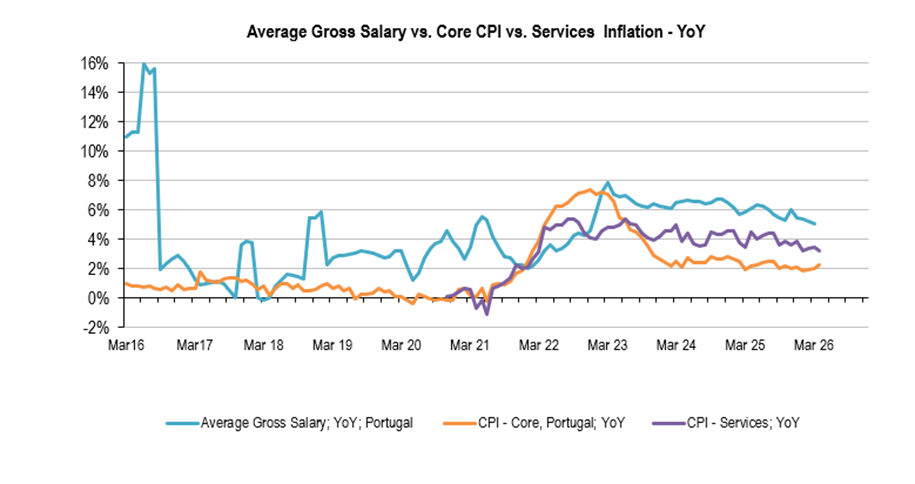
Summing up, average wage increases, over the 1Q26, 5.2%YoY; below 12MMA, 5.6%; meanwhile, March increase, 5.0%YoY, was the lowest figure since December 2022. Real wages remained close to 3%; however last inflation data is impacting real wages, now more close to 2% (salaries +5% and inflation +3%). So, is fair to assume that, over the coming months consumption would suffer, even so remains difficult to assess the full impact, while unions should start to demand higher salaries.
The Portuguese Statistic Institute released Friday, the 1Q26 gross monthly earnings per employee (per job).
We highlight the following:
- The monthly average gross salary over the 1Q25 was €1 728 and last 12 months: €1 708;
- The average increase over the 1Q26 was 5.20%YoY and 12MMA (12 months moving average): 5.6%;
- Average Monthly increases were Jan: 5.4%YoY; February: 5.2% and March: 5.0%;
- Average Core CPI over the 1Q26 was 1.9% and last 12 months 2.2% (Headline: 2.2% and 2.3%; respectively);
- Separately, the labour cost index (working days adjusted), released Thursday, regarding the 1Q26, pointed to +4.90%YoY vs. average of the last 4 quarters +5.7%;
- The labour cost Index in the Euro Area, was 4Q25: 3.4% (last data available).
Our comments: Nominal wage increases are smoothly adjusting, 5.0%YoY in March, the lowest increase since December 2022. The trend is negative, smaller increases, meanwhile inflation has recently increased, namely, April data, headline, 3.3% and Core data, 2.2%. Finally, the labour cost index in Portugal continues to increase at a higher speed than in Europe, less competitiveness, even so the gap is becoming smaller.
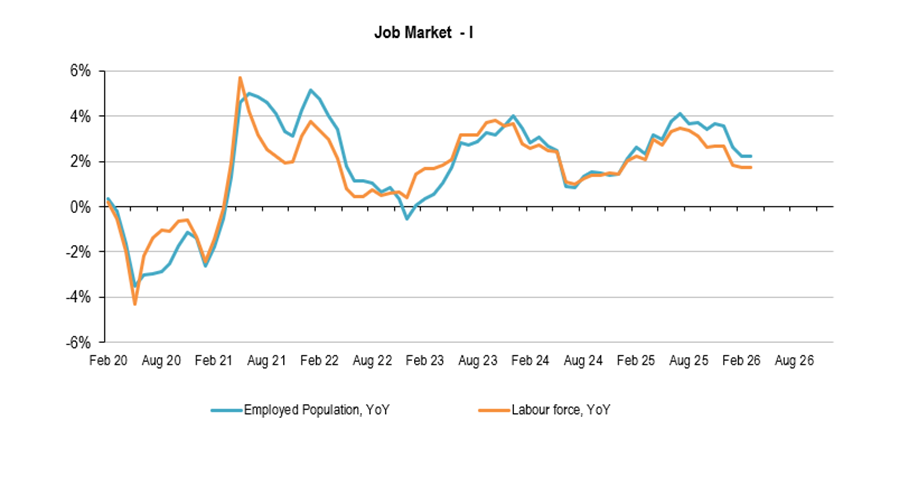
All in all, salaries in Portugal keep increasing above inflation, which bodes well for consumption, even so the spread is becoming smaller, salaries increased at 5%YoY in March below moving averages, while inflation has increased, namely in March, headline 2.7% and April, 3.3%. Finally, the gap between the labour cost index in Portugal, in March. 4.90%YoY (December: 7.6%) vs. Euro Area in December, 3.4% is becoming smaller, which means the competitiveness is smoothly improving (less negative).
Source: INE, AS Independent Research
António Seladas, CFA
Back