June 01, 2026
(reading time: 4 mins)
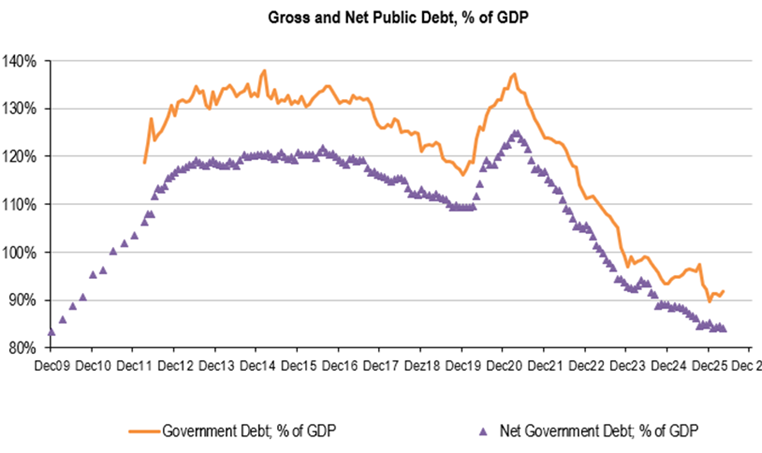
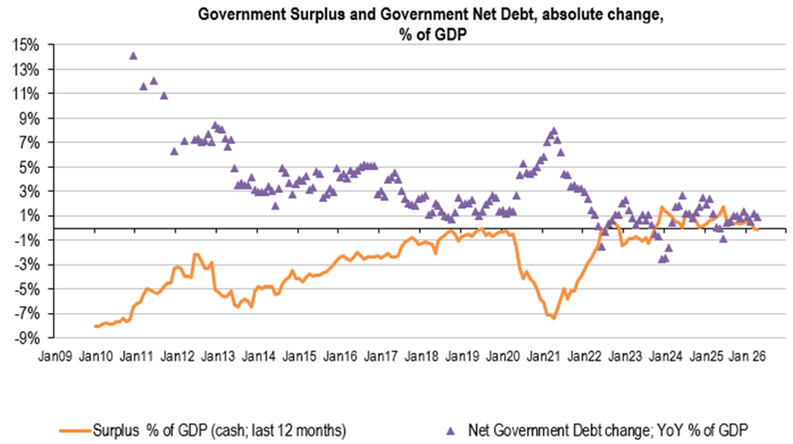
Government Debt, after deposits of public Administration, was almost flat in April(MoM) at €263Mn, while according to Maastricht definition (before deposits), increased roughly €3.9BnMoM to €287Bn, around 91.8% of GDP (target YE26: 87.5%), above 3MMA, it was mainly higher deposits. Meanwhile, the budget execution in April (YtD), deficit €1,548Mn, vs. a surplus of €154Mn in April 2025 (YtD), partially explained by non-recurrent payments made by the SNS, €1,134Mn in March and April. Even so, adjusting the figures the deficit would be €413Mn vs. a surplus of €154Mn in April2025YtD. Effective Revenues +5.7%YtD are increasing below Expenditures, +10.5%YtD or 7.3% (excluding the specific payment). On the revenue side, IRS, VAT, and IRC keep growing low single digit, while Contributions (mainly social security contributions) +7.6%YtD, keep outperforming, even so below figures recorded in prior years. Finally, Expenditures, +10.5%; o/w, Employees: +7.0% and Current Transfers: +5.6%; continue to grow above 5%.
The Bank of Portugal has just released April’s Government debt data.
The main highlights are the following:
1 – Gross Government debt (Maastricht definition): €287,079Mn; +222bpYoY/+138pMoM and 91.8% of GDP last 12months vs 12MMA (12 Months Moving Average): 93.5% and 3MMA: 91.3% (target YE26: 87.5%);
2 – Net Government debt (after the deposits of Public Administration; Maastricht definition): €263,167Mn +107bpYoY/flat MoM (+€1,446Mn YtD) and 84.1% of nominal GDP vs. 12MMA: 85.4%/3MMA: 84.3%.
Separately, the finance minister released Friday evening, April’s budget execution. We would highlight the following:
1 – Deficit: €1,548Mn YtD (January till April); +€1,702Mn vs. 2025 (higher deficit);
2 – Deficit in percentage of GDP, on a cash basis, last 12 months: -0.13% vs. 12MMA: +0.53% and 3MMA: +0.07% (surplus);
3 – Effective Revenues: +5.7%YtD vs. 12MMA: 8.1%/3MMA: 5.7% (initial budget 2026: +8.6%);
Direct Taxes: +3.4%YtD vs. budget: +2.0% (IRS: +3.1% and IRC: -20%);
Indirect Taxes: +1.3%YtD vs. budget: +4.9% (VAT: +0.7% and “Tax on oil…”: +2.8%)
Contributions (mainly social security contributions, CGA…): +7.6%YtD vs. budget: +5% (12MMA: 8.1%/3MMA: 7.3%);
Non-Tax and Non-Contributory Revenues (dividends, transfers…): +13.7%YtD vs. budget +30.5%.
4 - Effective Expenditure +10.5%YtD vs. 12MMA: 9.4% and 3MMA: 12.2% (initial budget: +10.5%);
Employees: +7.0%YtD vs. budget, 4.8%;
Purchase of Goods and Services: +30.5%YtD vs. budget: +2.3%;
Interest and Other Charges: +3.1%YtD vs. budget +5.1%;
Current Transfers (mainly pensions and social support): +5.6%YtD vs. budget: 6.6% (Pensions, unemployment benefits…: +4.1%YtD and “CGA” (civil servant pensions): +4.5%);
Others (subsidies, Investment…): +19.1% vs. budget: 47.7%.
Comment: Public debt, Maastricht definition, in April, underperformed +€3,897Mn MoM; to €287Bn, roughly 91.8% of GDP, while after Deposits, debt was almost flat MoM at €263Bn, lower than the deficit increase, €1.76Bn MoM, so a positive performance.
Concerning April budget execution, the deficit is now €1,548Mn YtD +€1,706Mn than in April 2025; partially explained by several payments, until April, totalling €1,134.3Mn, made by the SNS (National Healthcare System) and justifies the “Purchase of Goods & Services” performance, +30.5%YTD (+9.9%YoY in April). Adjusted by the extraordinary payment the deficit would be €413Mn, still higher than the surplus in 2025: +€154Mn. Nevertheless, the performance is clearly under pressure, Effective Revenues +5.7%YoY, below target (+8.6%YoY), while Expenditures, +10.5%YoY in line with the target.
Revenues, +5.7%YTD, o/w Direct Taxes: +3.4%; Indirect Taxes: +1.3%, Social Security Contributions: +7.8% (still outperforming) and non-tax/non-contributory revenues: +13.7%; are showing signal of weakness, while expenditures +10.5%YoY, o/w Employees: 7%YtD and Transfers +5.6%; basically structural expenditures, continue to grow.
Source: Bank of Portugal, INE, AS Independent Research
António Seladas, CFA
Back